Table of Contents
ToggleHard water affects roughly 85% of American homes, leaving mineral deposits on fixtures, appliances, and skin. Installing a water softener is a practical investment, but the cost can range wildly depending on what you choose and how complex your setup is. Whether you’re looking at a simple ion-exchange system or a whole-house solution with installation labor, understanding water softener costs upfront helps you budget properly and avoid sticker shock. This guide walks you through what drives pricing and where your money actually goes.
Key Takeaways
- Most homeowners spend $1,500–$4,000 for a complete whole-house water softener system installed, with ongoing maintenance adding $100–$400 annually.
- New water softener cost varies significantly by type: ion-exchange systems are the most affordable ($1,500–$4,000), while salt-free and dual-tank options range from $2,300–$5,500.
- Installation labor costs depend on complexity, ranging from $500–$1,200 for simple setups to over $3,000 for complex installations involving finished walls or multiple plumbing modifications.
- Getting multiple itemized quotes from licensed technicians and separating equipment costs from labor can save 10–30%, especially if you purchase the softener separately.
- Proper maintenance like annual salt replenishment, filter changes, and professional service extends system lifespan to 15–20 years and prevents costly repairs or premature failure.
What Affects Water Softener Pricing
Water softener costs depend on several interconnected factors. The system type, capacity, your home’s plumbing layout, and labor complexity all play a role. Understanding these drivers helps you spot a fair quote from a contractor and know where corners can’t be cut.
System Type and Capacity
The biggest cost variable is the system itself. A compact point-of-use softener (treating water at one tap) runs $300–$800 and requires no installation. A whole-house ion-exchange softener, the most common residential choice, costs $1,000–$3,000 for the equipment alone. Larger capacity units designed for families of 4–6 and higher hardness levels sit at the higher end.
Salt-free conditioning systems (also called descalers or template-assisted crystallization) cost $1,500–$4,000 but don’t require ongoing salt purchases, a trade-off worth calculating if you’re in a low-salt-discharge area. Dual-tank softeners, which let your home run on one tank while the other regenerates, cost $2,500–$5,500 and appeal to high-volume users. Reverse osmosis systems for drinking water only run $500–$2,000 but only treat the kitchen tap.
Capacity matters too. Softeners are sized in grains per gallon (GPG) of hardness they can handle before needing regeneration. A home with 10 GPG hardness and four occupants typically needs a 32,000–40,000 grain system: jumping to 64,000 grains adds $300–$600 to the equipment cost.
Installation Complexity and Labor
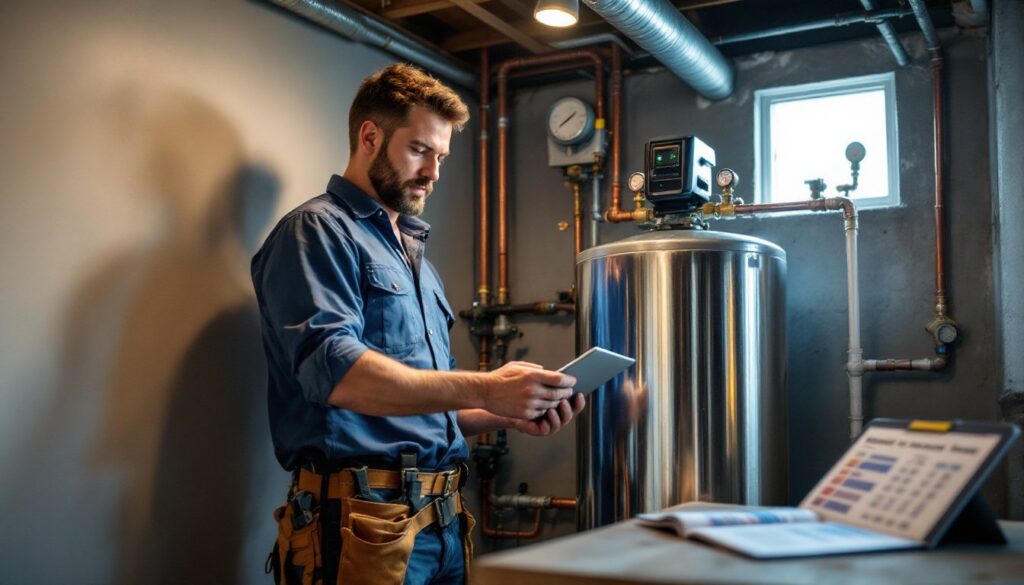
Where your softener sits and what plumbing changes it requires directly impact labor costs. An easy installation, straight connection to incoming water line in an unfinished basement with room to work, runs $500–$1,200 in labor. The technician bypasses the existing supply line, installs the unit, and you’re done in 2–3 hours.
A moderate installation with some complications, moving the unit location, running new copper or PEX lines, installing a bypass valve, or mounting in a tight mechanical closet, costs $1,200–$2,500. Complex installations involving running lines through finished walls, creating new access points, or integrating with radiant heating or recirculation systems can exceed $3,000. If your home requires a permit (many municipalities do), add $100–$300 in fees and an inspection visit.
Local labor rates matter enormously. A technician in a major metro area charges more per hour than one in a rural region. Seasonal demand also shifts pricing, spring and summer bring higher rates as homeowners address hard water ahead of outdoor projects.
Average Cost Breakdown by System Type
Here’s what homeowners typically spend on different water softener setups, including equipment and standard installation:
Ion-Exchange Softeners (Most Popular)
- Equipment: $1,000–$2,500
- Installation: $500–$1,500
- Total: $1,500–$4,000
The workhorse of residential water treatment. Requires periodic salt replenishment (40–50 lb bags, roughly $5–$8 per bag, several per year depending on water use and hardness). Regeneration wastes some water, typically 20–30 gallons per cycle, and softened water requires a separate tap for drinking if you prefer unmineralized water for cooking.
Salt-Free Conditioning Systems
- Equipment: $1,500–$3,500
- Installation: $800–$1,500
- Total: $2,300–$5,000
No salt to buy, lower water waste, and works via crystallization rather than ion exchange. Popular in areas restricting salt discharge. Doesn’t actually soften water (minerals remain) but prevents scale buildup. Works well for moderate hardness: less effective beyond 10 GPG.
Dual-Tank Ion-Exchange
- Equipment: $2,000–$4,000
- Installation: $800–$1,500
- Total: $2,800–$5,500
Ideal for large families or very high-volume water users. One tank regenerates while the other serves the home, so you never run out of soft water. Double the equipment cost but eliminates downtime frustration.
Point-of-Use Systems
- Equipment: $300–$1,000
- Installation: $0–$300 (DIY-friendly)
- Total: $300–$1,300
Treats only one faucet, usually the kitchen or shower. Makes sense for renters or if your hardness is localized. Limited flow rate and frequent filter changes (every 6–12 months, $50–$150 each) add ongoing costs.
According to HomeAdvisor’s water softener installation cost guide, most homeowners spend between $1,500 and $4,000 for a complete system installed. Regional variation is significant: installations in California or New York run 20–40% higher than rural areas.
Installation and Ongoing Maintenance Expenses
The upfront hardware cost is only part of your investment. Installation labor, permits, and recurring maintenance add real dollars over the system’s lifespan.
Installation Costs Breakdown
Standard residential installation by a licensed technician runs $500–$2,500 depending on complexity. This includes:
- Removing old equipment (if replacing)
- Running and connecting supply lines
- Installing bypass valve and check valve
- Pressure tank (if applicable)
- Testing and startup
- Paperwork and permits
If you hire a general plumber rather than a water treatment specialist, expect higher labor rates but potentially lower equipment markups. Many contractors bundle equipment + labor into a single quote, which sometimes obscures the true cost division.
Ongoing Salt and Maintenance
An ion-exchange softener uses 40–50 lbs of salt per regeneration cycle, which occurs every 3–14 days depending on water hardness and household size. At $5–$8 per bag, budget $100–$300 annually for salt alone. Some homeowners opt for potassium chloride instead of salt (better for septic systems and salt-sensitive areas) at roughly double the cost.
Annual maintenance service (cleaning resin tank, checking valves, inspecting brine tank) costs $100–$200 if purchased separately or $150–$300 as part of a service contract. Filter replacements for sediment prefilters run $20–$50 each and should be swapped annually. Missing these allows sediment to foul the resin beads, shortening system life.
Repair Costs
Resin bead replacement (typically at 10–15 years) costs $400–$800 if done by a technician. A new brine tank (if corroded) runs $200–$400. Most systems last 15–20 years with proper maintenance: neglected systems fail by year 8–10.
Platforms like Angi and ImproveNet let homeowners compare contractor quotes and see average repair costs in their area, helping you spot overpriced service calls.
Budgeting Tips and Cost-Saving Strategies
Smart shopping and honest maintenance decisions trim costs without sacrificing performance.
Get Multiple Quotes
Never accept the first estimate. Call three licensed technicians or water treatment specialists, describe your water hardness (get a test kit from a hardware store, $10–$20), and ask for itemized quotes separating equipment, labor, and permits. Compare apples to apples: the cheapest quote often means less capable equipment or hidden add-ons later.
Buy Equipment Separately from Installation
Some homeowners purchase a softener online (10–30% cheaper than contractor pricing) and hire a plumber for installation only. This works if you know exactly what you need and the plumber will honor a warranty from an outside vendor. Verify this arrangement upfront: some contractors refuse to service systems they didn’t sell.
Choose System Size Correctly
Oversizing costs money upfront and wastes salt on unnecessary regenerations. Undersizing means frequent recharging and poor performance. A free water hardness test from most local water utilities or your softener dealer gives you the right capacity to spec. Size for your actual household, not your dream family.
Consider Used or Refurbished Units
A refurbished softener from a reputable supplier costs 30–50% less than new and comes with a warranty. Used units are risky unless you personally inspect them and test the resin. Not ideal for renters or if you plan to stay less than five years.
Skip Extended Warranties
Water softeners have few moving parts: most failures stem from poor maintenance, not defects. A standard manufacturer warranty (typically 5–10 years on the tank, 2–5 years on valves) covers genuine defects. Extended warranties rarely pay for themselves.
DIY Salt Top-Ups and Filter Changes
You don’t need a technician to refill the brine tank with salt or swap a sediment filter. Watch the manufacturer’s video, keep bags on hand, and mark your calendar. This single habit saves $200–$400 annually in unnecessary service calls.
Conclusion
Water softener costs in 2026 reflect equipment choice, installation complexity, and your region’s labor rates. Most homeowners invest $1,500–$4,000 for a whole-house ion-exchange system installed, with ongoing salt and maintenance running $100–$400 yearly. Get itemized quotes, right-size your capacity, and commit to basic maintenance, that’s how you avoid overpaying and ensure your softener lasts its full 15–20 year lifespan. Hard water won’t fix itself: planning your budget now prevents frustration later.